|
Israel Audo
Who made the East- Aramean Nestorians known as "Assyrians"?
SUA/WCA and allowing terrorism
Aramean history, history, culture and language, a six partite interview
21-1-2013: Iraq: Aramean teacher and student killed in Mosul
22-2-2012: Iraq: We have left behind a "sovereign, stable and self-reliant Iraq"
19-8-2011: Iraq and Arameans: The usual ritual, blowing up their churches
7-6-2011: The uproar in the Middle-East and the future of the Aramean nation
29-4-2011:
“Liberation” of
23-11-2010: Aramean blood continue to flow in Iraq: Two Aramean brothers killed in Mosul
11-11-2010: An Aramean spiritual leader makes a dramatic appeal: Leave Iraq
1-11-2010: Bloodbath among the Arameans of Baghdad: Something like this never happened
17-5-2010: Iraq: The 19 years old Aramean girl Sandy Shabib Hadi Zahra succumbs to her injuries
10-3-2010: Exodus Arameans from Mosul: According to recent UN report more than 5000 Arameans have left Mosul
27-2-2010: Council of Churches in Iraq appeals to the government to protect the Aramean people in Mosul, Iraq
26-2-2010: The Arameans of Mosul: A new Exodus and Ethnic cleansing is going on
18-2-2010: The Arameans of Iraq again victim of killings and bloodbaths:
24-12-2009: A Christmas “message” for the Arameans of Mosul: Four Aramean Churches attacked and one Aramean killed
1-9-2009: Arameans of Iraq: The East- Aramean Chaldean bishop Louis Sako of Kirkuk sounds the alarm bell
29-8-2009: Totally unfounded or has it a grain of truth in it? Greater- Israel and the ethnic cleansing of the Arameans of Mosul and surroundings in Iraq
13-7-2009: Seven Indigenous Aramean Churches in Baghdad (Iraq) attacked by car bombs
4-5-2009: Aramean blood continues to flow in Iraq…
15-11-2008: Iraq: The bloodshed of Aramean people and bombardment of churches continues undiminished
27-10-2008: Attempt of ethnic cleansing Mosul: The Aramean Srebrinica. Who is responsible and why?
2-9-2008: Again two Arameans killed in Iraq
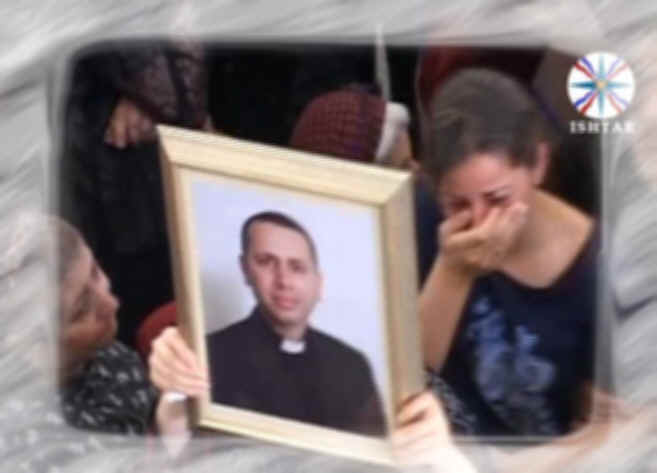
Killing of Priest Yusuf Adel Abudi
4-5-2008: Again a Aramean spiritual leader is killed in Iraq. This time: The West- Aramean Syrian orthodox priest Yusuf Adel Abudi in Bagdad
11-4-2008: Through all the misery: Miracles happens in Iraq
6-4-2008: Funeral of the West- Aramean Syrian Orthodox Priest Yusuf Adel Abudi
Killing of Mgr. Faraj Raho
1-3-2008: East- Aramean Chaldean bishop of Mosul, Mgr. Paulus Faraj Raho was abducted on 29-2-2008 in Mosul.
13-3-2008: The East- Aramean Chaldean bishop Paulus Faraj Raho killed in Mosul
14-3-2008: Friday 14-3-2008: Funeral of Mgr. Faraj Raho in St. Addai Church in Karemlesh
16-3-2008: Mgr. Paulus Faraj Raho: A Great Spiritual Leader and a Worthy Sheppard in Charge of Jesus Christ
23-2-2008: Aramean centre for art and culture has been opened in Ankawa, northern Iraq
7-1-2008: Aramean Churches and institutions in Iraq under Attack
Killing of Priest Ragied Aziz Gannie
25-5-2007: Terror against Arameans (including "Assyrians" and Chaldeans) of Iraq. Ethnic cleansing of the Indigenous people of Iraq
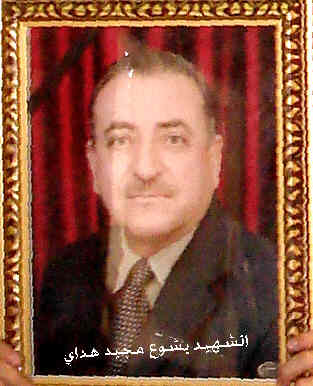
Killing of Isoh Majeed Hadaya
22-11-2006: The West- Aramean Isoh Majeed Hadaya killed by terrorists in Iraq
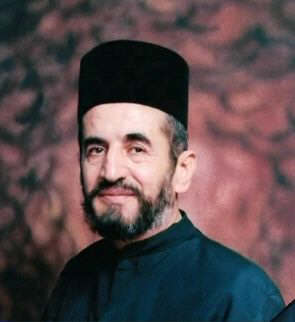
Killing of Priest Paulus Iskandar
12-10-2006: Aramean priest Iskandar beheaded in Mosul (Iraq) |
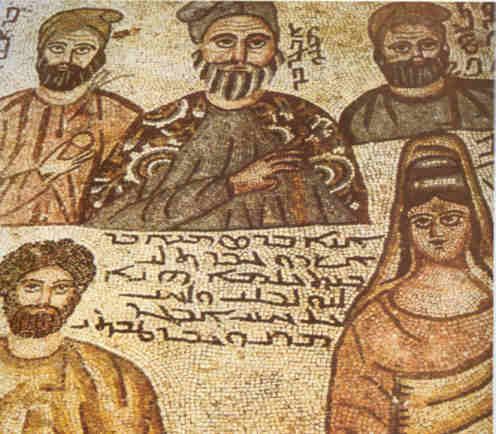
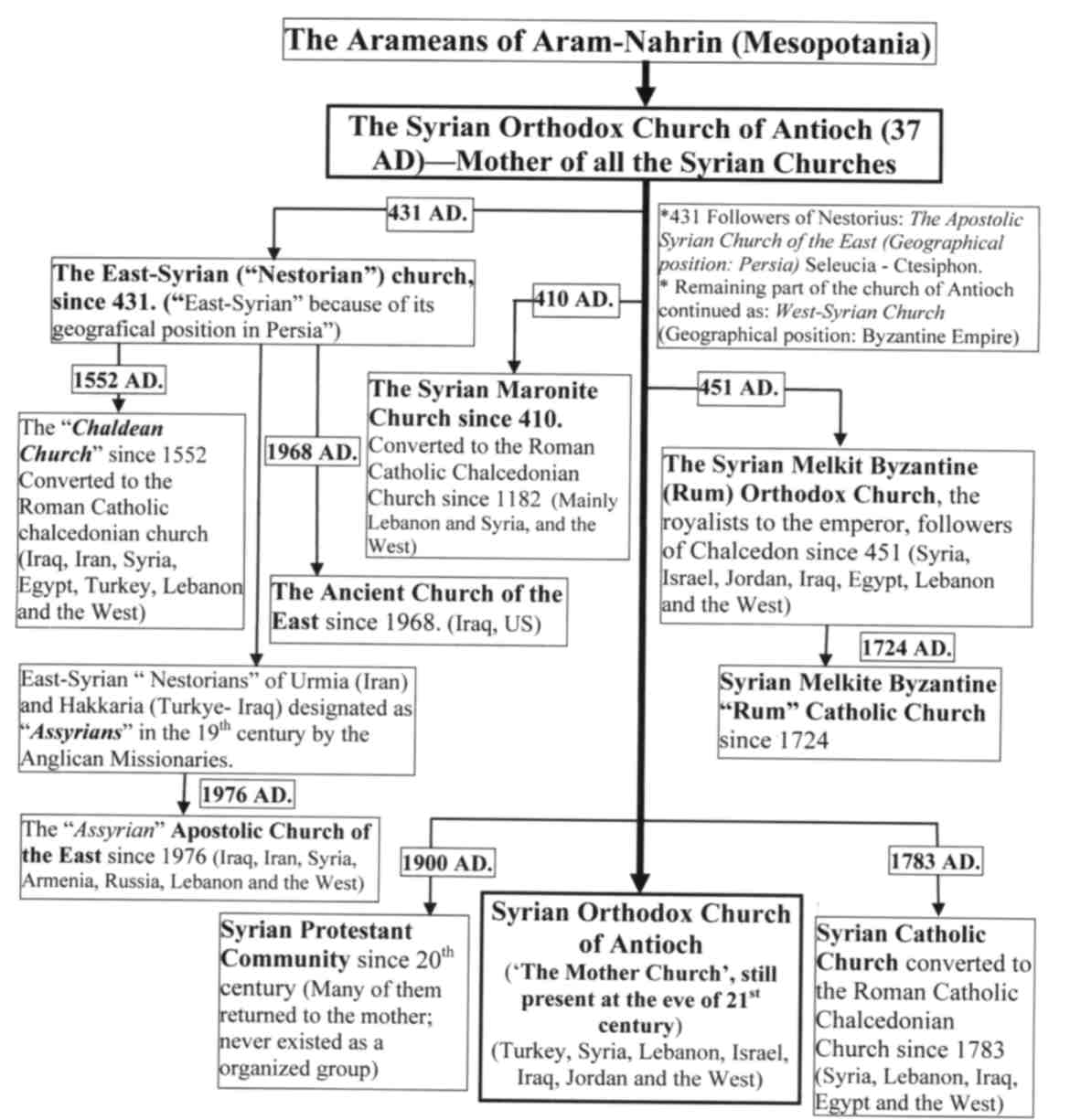
Aramean people: Aramean people (not to be confused with ‘Armenians’) speak Aramaic, the language spoken by Abraham, Moses and Jesus. They are the indigenous people of what was called in ancient times Aram- Nahrin, in our days it is called ‘Mesopotamia’. Some Arameans today identify themselves with “Assyrians”, because of the spiritual colonial hate generating activities of the Western missionaries and diplomats in the Middle-East in 16th and 19th centuries. Other Arameans became known as “Chaldeans”. However all of them are Arameans. In Turkey, the Arameans are called: Süryani. In Arabic they are called Al- Suryan.
Economic and Social Council of the United Nations COMMISSION ON HUMAN RIGHTS Sub-Commission on the Promotion and Protection of Human Rights Working Group on the Indigenous Populations - 24th session Geneva, Switzerland: 31 July – 4 August 2006 Read out loud: Thursday 3-8-2006 Oral statement under item: 5. Standard-setting: (b) Possible new studies to be undertaken. Proposal: Media Ombudsman for indigenous peoples Mr. Chairman; In the framework of new studies to be undertaken, we propose: Media Ombudsman for Indigenous peoples. However, please allow me first to explain the reason for that. In our statement under item 4 (a)[1] we showed to you, in the framework of the decline of the Aramean heritage, the misrepresentation and misinformation of the Indigenous Aramean people of Aram-Nahrin by the mass media, governments and even by some human rights organizations. We felt that our rights were deliberately being violated in a way that contradicts the recorded testimonies [2] regarding our heritage and factually couldn’t do anything about it. It is quite insulting and harsh to observe, as an indigenous nation, that your cultural heritage is being distorted and you have no adequate means to defend your rights. We couldn’t go to anywhere or anybody with this violation of our rights and felt powerless. We missed solidarity and support in this matter; no institution or organizations could help us in this matter; except the possibility to inform the high commissioner for Human Rights about these violations .[3] We believe that there are more indigenous peoples who experience the same or perhaps worse. For example that some of them became victim of government propaganda for political reasons or to deny their claims of being indigenous people. Or perhaps became victim of the propaganda of some of their own people who were bribed and brainwashed. For this reason we present to you the following proposal in the framework of Possible new studies to be undertaken: Perhaps it would be meaningful to undertake a feasibility study to Indigenous peoples access to the media with the aim to create of what we would call a Media Ombudsman for indigenous peoples. The main goal of such Ombudsman would be the correct representation of indigenous peoples by the mass media, governments and others. This person should be, to our view, provided with means, authority and responsibility to instantly act adequately when the indigenous peoples are being misrepresented whether deliberately or not by the press, governments and others. At least this person should make note of these violations and report to the UN organizations and institutions of interest. Of course Mr. Chairman; the working group on indigenous populations is a good platform where indigenous peoples every year can vent their feelings and share their experiences. Roughly speaking, the story of all of them is more or less the same and comprises amongst others: discrimination, exclusion, persecution, ethnic cleansing, misrepresentation and destruction of their cultural heritage. Therefore, we do not expect miracles as to media Ombudsman. However we believe that a media Ombudsman would benefit the rights of all the indigenous peoples. Furthermore, the advantage of such Ombudsman to the indigenous peoples would be that you have somebody to whom you specifically can address the misinformation of your nation. As indigenous nation you than have something in your hand when you talk with media, governments and others; you have somebody at your side who is supporting you. Correct representation of Indigenous peoples may also help to better understanding of their cultural background; traditional knowledge and to attain their rights including recognition as indigenous people by governments.
Thank you
Gabriel Sengo (President) Arameans of Aram-Naharaim Organization P.O. Box 178 7550 AD Hengelo(Ov.); Netherlands Footnotes [1] Testimonies of the brilliant historians of the Syrian Church of Antioch regarding the synonymy Aramean/Syrian: https://www.aramnahrin.org/English/Testimonies-Aramean-scholars.htm [2] Testimonies of the brilliant historians of the Syrian Church of Antioch regarding the synonymy Aramean/Syrian: http://www.aramnahrin.org/English/https://www.aramnahrin.org/English/Testimonies-Aramean-scholars.htm [3] See our comprehensive report of 7th of March 2005 sent to the High Commissioner for Human Rights. Background information on Aramean people (including “Assyrians” and Chaldeans)
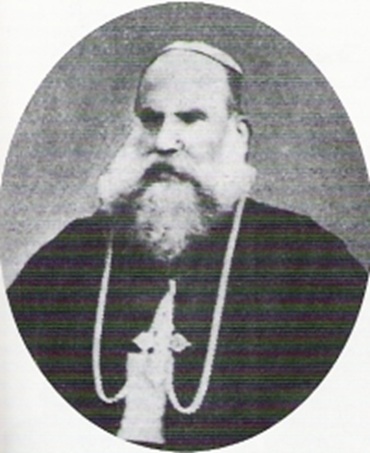
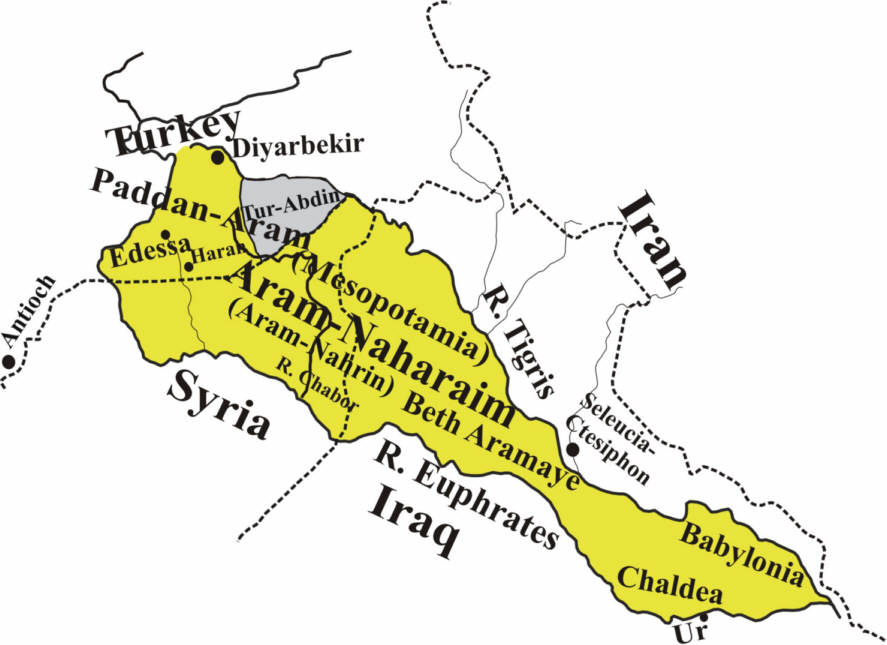
The area where the Aramean people come from was known as “Mesopotamia” and has been divided into the modern countries Iraq, Syria, and Turkey since the 20th century. In the ancient times the cradle of the Aramean forefathers was called Aramnahrin (or: Aram-Nahrin) in Aramaic. In Hebrew it was called Aram-Naharaim which we encounter in the Old Testament. When the Old Testament was translated into Greek, the term Aram-Naharaim was translated into Mesopotamia, which many become familiarized with through reading many educational and historical texts. The northern area of Aram-Naharaim was called Paddan-Aram, meaning the land of Aram where Biblical figures like Abraham and Jacob lived and walked. In Genesis 24:4 Abraham says to his servants, “You must go back to the country where I was born and get a wife for my son Isaac from among my relatives." Abraham says, “….the country where I was born….” meaning the country of his Aramean fathers Paddan-Aram (part of Aram-Naharaim). Roughly speaking, this area is situated in present south-eastern Turkey. A section of Paddan-Aram is now called Tur Abdin in the Aramaic (Syriac) language, which means “the mountains of the servants of the Lord”, due to the overwhelming presence of monasteries and churches. According to the Aramean historical traditions, the area of Paddan-Aram- in particular ‘Tur Abdin’ – is the proto-land of the Aramean nation. From this proto- or indigenous land, in the course of time, the Arameans started to expand all over the near east. Because of overwhelming presence of Arameans in the southern part of Aram-Nahrin, in the era of early Christianity, it was called Beth-Aramaya, meaning (in Aramaic) “the house of the Arameans”. Regarding Beth Aramaya, Yacob Avgin Manna (Jacques-Eugene Manna 1867-1928), Bishop of the East-Aramean Chaldean church wrote, “The people from Babylon and Assur, are Arameans. The countries of Babylon and Assur were always called Beth Aramaye, that means country of the Arameans.” [1] Regarding the proto-land “Tur- Abdin”; the East- Aramean Chaldean metropolitan Aday Sher, born in 1867 in Shaqlawa [Northern Iraq] and became the archbishop of Seert [Turkey]; says,, "The first inhabitants of Tur Abdin are the Arameans, for they inhabited the whole Mountain of Masios... This is also repeated by Patriarch Afrem Barsauwm[2], also called ‘the star of the middle-east’ Aramean people (including “Assyrians” and Chaldeans) and the Christianity After the coming of Jesus Christ, the Arameans (including Assyrians and Chaldeans) of Aram-Naharaim accepted the teachings of Christ and established together with the apostles of Jesus and the converted Jews, the Syrian Church of Antioch, the second Patriarchy after Jerusalem, where for the first time the followers of Jesus Christ were called Christians (Acts 11:26). This church was the mother of all the Churches and the first Church established outside Israel, whose Patriarch currently resides in Damascus, Syria[3]. The Semitic Arameans (‘not to be confused with “Armenians”) underwent a change of name after they had embraced Christianity and were then called “Syrians”[1], in order to be distinguished from the Arameans who were not converted. However, this should not be confused with the present-day Syrian Arabs. In deeper sense, the name "Syrian" belongs to the Aramean people and not to the Arabs invaders. However, after the conquer of Mesopotamia by Arabs, they adapted the name "Syrian"; with the result that the real Syrians, that is to say: Arameans; became strangers in their own indigenous lands. The Arameans were spread throughout middle-east. However, in the very beginning of the Christianity; geographically they were divided into East-Arameans; those living in Persian Empire and West-Arameans; those living in the Roman (Byzantine) Empire. The Church in the Roman Empire: Syrian orthodox church of Antioch; the mother Church; with Antioch as the Ecclesial Jurisdiction. The Church in Persia: The Church of the East or the Church of Persia, Seleucia Ctesiphon and the seat of the Catholicos. However the Arameans in Persia were still under the jurisdiction of Antioch.
[1] Please find here the testimonies of the brilliant historians of the Syrian Church of Antioch concerning synonymy Aramean/Syrian for one and the same people; “Beth- Aramaye” or “Beth- Oromoye”; “Proto- land” Tur Abdin/Paddan- Aram: https://www.aramnahrin.org/English/Testimonies-Aramean-scholars.htm [2] http://www.aramnaharaim.org/ [3] More on the establishment of Syrian Orthodox Church of Antioch: http://www.aramnahrin.org/English/SyrianChurchOfAntioch.htm Iraqi Christians: http://www.iraqichristians.info
Copyright © Aram-Naharaim Organization. All rights reserved.
|
Letters to governments and international institutions
Aramean Spiritual/ Physical Genocide
Fake News on the Aramean nation:
1-12-2009: Aramean Organizations sent a letter to the new elected president of the European Union
10-14 August 2009: Aram-Naharaim attends the annual meeting of the UN Expert Mechanism On the Rights of Indigenous Peoples. Statement on the situation of the Aramean people in Syria, Turkey and Iraq
25-4-2008: Aramean Organisations ask for protection of Aramean spiritual leaders in Iraq
22-8-2007: Aram-Nahrin sends a letter to President George Bush, President Nicolas Sarkozy and Prime Minister Gordon Brown
31 July - 4 August 2006: Aram-Naharaim attends the 24th session of the Working Group on the Indigenous Populations
* Aramaic language in danger: Shall the language of Abraham, Moses and Jesus disappear?
* Proposal: Media Ombudsman for Indigenous Peoples.
* Report of Aram-Naharaim: A great success for the Aramean cause …. the Arameans and the UN…..
20-10-2005: Aram-Naharaim in action for the Arameans in Iraq
18-22 July 2005: Aram-Naharaim attends the 23rd session of the Working Group on the Indigenous Populations: A statement on “Spiritual Colonialism and the decline of the Indigenous Aramean people of Aram-Nahrin”
19-23 July 2004: Aram-Naharaim attends the 22nd session of the Working Group on the Indigenous Populations. Statement: The exclusion and discrimination of the Indigenous Aramean people of Mesopotamia (Aram-Naharaim)
|